

In a previous blog, I argued that Luke shows a sense of humor in Luke 8:25, which records the disciples’ comment that the wind and sea heard and did what Christ commanded as He calmed the storm on the Sea of Galilee. Prior to this, the Lord had told the disciples to get into a boat and cross the sea. As they were crossing, a storm arose. Their fearful and faithless response showed that they were not hearing and doing what the Lord had told them to do. The wind and sea were better disciples than the disciples, who admitted it with their own mouths. Luke also wrote the Book of Acts. The two books are part of a two-volume work. At the end of Acts, Luke himself got into a boat. As he boarded the boat, he probably thought about the incident recorded in Luke 8:25. The disciples had taught him a lesson.
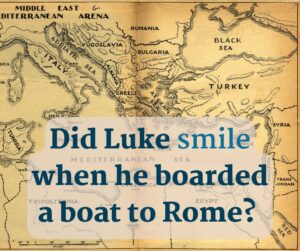
In Acts 28:11, Luke explains that he and Paul boarded a ship sailing across the Mediterranean Sea from Malta to Rome. Luke describes the figurehead attached to the front of the ship.
It was a carving of Castor and Pollux, two Greek gods. According to Greek myth, they were twins who had two different fathers, one of whom was Zeus, head of the Greek gods. They had their own stars and were the gods assigned to protect sailors on the sea. If sailors saw their stars in the night sky, they would have a safe journey. The figurehead would be a good luck charm for pagans getting on that boat. It proclaimed to all who got on board that the passengers were in good hands.
I realize that the darkness to which the pagan world was subject was not a laughing matter. But I have to think that Luke smiled when he saw that figurehead. In the first part of his written work (Luke/Acts), he recounts that Christ simply said the word, and the wind and sea became calm. Luke knew those two wooden “gods” could do nothing to ensure a safe journey to Rome. But Christ could.
Luke also knew that his readers would see the irony. They had already heard what happened on the Sea of Galilee, so they would get the joke. Paul and Luke relied upon the Lord to get them to Rome. The Lord had told Paul that he would go to Rome (Acts 23:11). The Lord’s word was their security, not a wooden representation of two false gods.
I wonder whether Paul and Luke spoke about the miracle on the Sea of Galilee as they boarded the boat. I know their hearts broke when they were reminded of the ridiculous superstition believed by many who sailed on the Mediterranean. But I also think they smiled as they remembered the power of Christ’s word. Did they chuckle at the dumb superstition that was right before their eyes?
I wouldn’t be surprised if they did. I’m sure Luke smiled when he learned of the disciples’ dumb reaction on the Sea of Galilee. Paul and Luke were grateful to the Lord for showing them the truth. They could rejoice in that as they relied on Christ’s word, not the superstitions of Greek mythology.

